
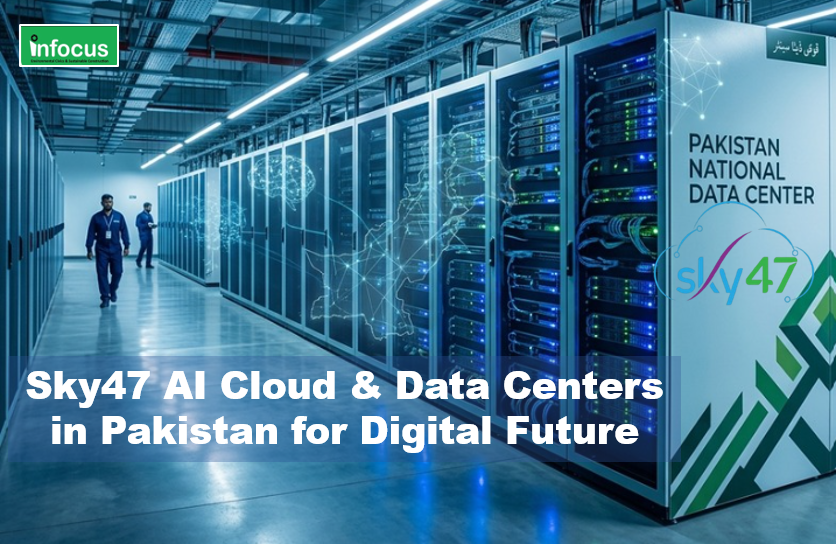
In today’s digital economy, data has become one of the world’s most valuable resources. Every online transaction, mobile payment, cloud application, government portal, social media interaction, and Artificial Intelligence (AI) service depends on secure and reliable data storage. At the heart of this digital ecosystem are data centers—highly secure facilities that house servers, networking equipment, and storage systems responsible for processing and safeguarding digital information. For Pakistan, experiencing rapid growth in digital banking, e-commerce, Fintech, cloud computing, artificial intelligence, and e-governance, the expansion of modern data centers is no longer optional. In fact, data centers in Pakistan are a strategic necessity for national development and digital sovereignty.
Data Centers in Pakistan:
Data Centers serve as the backbone of Pakistan’s digital transformation. They enable innovation, strengthen cybersecurity, support AI development, improve public services, and enhance economic competitiveness. Pakistan has witnessed encouraging progress in recent years with both local and international organizations investing in data infrastructure. Some notable data center already operative in the country are PTCL Data Centers, NADRA Data Centers, National Telecommunication Corporation (NTC) Data Centers, Multinet Pakistan Data Centers, Cyber Internet Services (Cybernet), Nayatel Data Centers and etc. These facilities provide services such as cloud hosting, disaster recovery, colocation, cybersecurity, managed hosting, and enterprise IT infrastructure for businesses, financial institutions, telecom operators, and government agencies.
As Pakistan moves toward a knowledge-based economy, investing in modern, resilient, and sustainable data centers are certain to be critical to ensuring that the country’s digital future is secure, self-reliant, and globally competitive. Then, significance of data centers has grown with the emergence of AI technologies. Artificial intelligence applications require enormous computing power and vast datasets to train and operate efficiently. Besides, Pakistan still has a relatively small number of hyper-scale and Tier-III or Tier-IV certified data centers compared to regional competitors such as India and the Gulf states. Yet, the year 2026 seems to be the of digital overhauling of Pakistan data governance and digitalized transformation.
Sky47 AI Cloud Data Center:
Last week Prime Minister Shehbaz Sharif together with Chief of Defense Forces and Chief of Army Staff Field Marshal Asim Munir inaugurated the country’s “largest” data center and Sky47 AI Cloud in Islamabad. The project has a capacity of 8.5 megawatts. Sky47 is also developing a 5MW data center at Karachi’s Port Qasim, slated for completion in September. Characterizing the data center as “the future of Pakistan”, PM Shehbaz also stated the facility “offers impregnable security and… gives us this hope and encouragement that everything is doable provided we put our act together”.
While Minister for IT and Telecom Shaza Fatima Khawaja said the Sky47 AI Cloud provided Pakistan with the foundation of an infrastructure …. as every opportunity in the future would be reliant on access to high performance computing — including in healthcare, agriculture, economy, financial services, education, public administration and national security.
Growth in Data Centers:
Pertaining to development and recent growth of Data Centers in the country, it is notable to mention that Pakistan’s first-ever locally hosted AI data center and sovereign AI cloud was launched by Telenor in partnership with Data Vault in November 2025. Last month, Quantum Global Data Centre (QGDC), a venture of the Gul Ahmed Energy Group, announced plans to develop Pakistan’s largest Tier III data center, which is expected to become operational in 2027 with an initial investment of $230 million. QGDC signed a strategic partnership agreement with Huawei Pakistan to develop the facility and a science and technology park to support Pakistan’s digital transformation.

The push towards AI has been prominent on the governmental level recently as departments like the Federal Board of Revenue have launched AI-based internal systems to enhance transparency, reduce human intervention and improve tax collection efficiency. In February 2025, another data center was inaugurated at the NED University of Engineering and Technology. The facility, according to university officials, was the country’s first “Tier-III certified data center” aimed at providing best IT services to the public and the private sector.
Towards Digital Pakistan:
The government’s vision for Digital Pakistan further reinforces the need for robust data infrastructure. E-governance initiatives, digital identity systems, online education, healthcare platforms, smart cities, and digital taxation all require secure, uninterrupted, and scalable computing resources. Similarly, Pakistan’s rapidly expanding Fintech and digital payment ecosystem depends on low-latency, highly available infrastructure to ensure secure financial transactions. However, much of the country’s digital data continues to be hosted abroad, leading to capital outflows and raising concerns over data localization and national security.
Data centers contribute significantly to economic growth. They create high-skilled employment opportunities in information technology, engineering, cybersecurity, electrical systems, networking, and facility management. As Pakistan’s IT exports continue to rise, world-class digital infrastructure will be essential to attract foreign direct investment and multinational technology companies. But without local data centers, Pakistani businesses often rely on overseas cloud infrastructure, resulting in higher costs, increased latency, data privacy concerns, and dependence on foreign service providers.
Looking ahead, Pakistan should encourage greater investment in green and energy-efficient data centers powered by renewable energy. Policies that provide tax incentives, reliable electricity, high-speed fiber connectivity, and simplified regulatory approvals can help accelerate the establishment of modern facilities. International cloud providers such as Microsoft, Google, Amazon Web Services (AWS), Oracle, and Alibaba Cloud would also find Pakistan more attractive if local data center infrastructure and supporting regulations continue to improve.
By
Editorial, Infocus.pk