
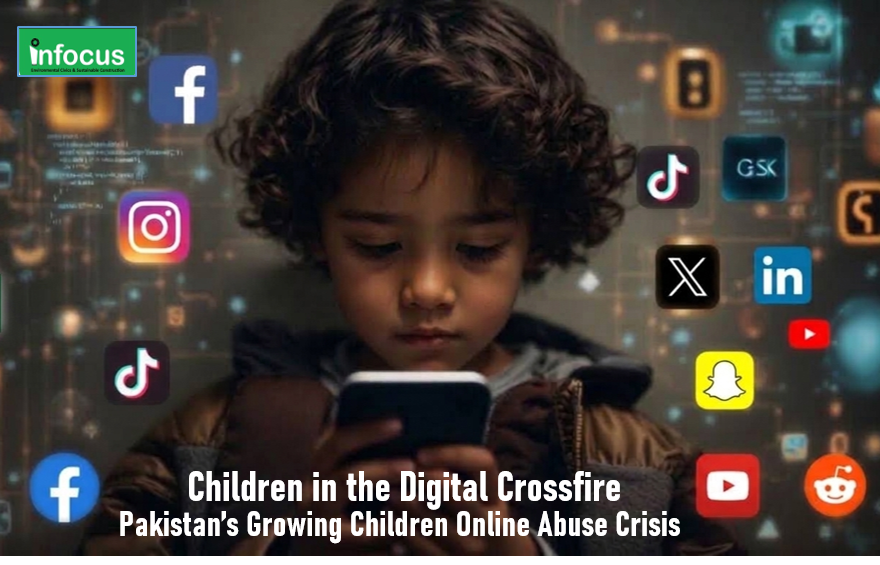
The rapid expansion of social media and digital communication has created unprecedented opportunities for children to learn, communicate and express themselves. But it has also exposed them to serious forms of sexual exploitation and abuse. This growing children online abuse crisis directly undermines the mental, emotional, and social well-being of the country’s youth. Without immediate legislative reforms, stronger digital surveillance, and widespread public awareness, this escalating crisis risks crippling the potential of the next generation.
Children Online Abuse Crisis:
The scale of the children online abuse crisis is reinforced by new international research. UNICEF estimates that around 20 million internet-using children across 21 countries experienced sexual exploitation or abuse on digital platforms in a single year. More than one in five surveyed children aged 12 to 17 reported at least one such experience. Pakistan is among the countries covered by the research.
As, Pakistan is now confronting a growing volume of digital evidence linked to such crimes, with the National Cyber Crime Investigation Agency (NCCIA) reporting nearly one million referrals annually. In response, the agency launched Katalyst, an AI-enabled investigative tool in January 2026 to help detect, prioritise and investigate online child sexual exploitation cases.
Social Media at the Centre of the Risk:
Social media platforms constitute a major part of the problem. UNICEF’s research found that almost 60% of reported abuse occurred on social media, with Facebook, WhatsApp, Instagram, Snapchat and TikTok among the platforms identified. Online gaming accounted for another 14%. The research also found that fewer than 1% of cases were reported to police, social workers or helplines, highlighting a major reporting and protection gap.
Girls can face particular risks, including sexual extortion and the subsequent social consequences that may restrict their mobility or contribute to withdrawal from education. The emergence of AI-generated sexual imagery has added another dimension: UNICEF reported that in nine countries surveyed, an estimated 1.1 million children experienced AI-generated sexual images or videos depicting them.
Pakistan considers an Age Barrier:
The policy response has increasingly focused on age restrictions. Punjab’s provincial assembly has passed a resolution seeking restrictions on social-media use by children under 16. At the federal level, the Social Media (Age-Restricted Users) Bill, 2025 proposed preventing under-16s from holding accounts on designated platforms. However, the Senate’s official record shows that the private member’s bill, introduced in July 2025, was subsequently withdrawn on August 18, 2025.
This distinction is important: a proposed age restriction is not the same as an enacted nationwide law. Meanwhile, judicial proceedings and policy consultations concerning stronger protections for children remain part of the wider debate.
Technology Companies also face Pressure:
Technology companies say they have introduced safeguards. Meta has pointed to measures such as private-by-default teen accounts and restrictions on certain adult-to-teen interactions. Snapchat says it uses proactive detection, account removals and reporting mechanisms, while TikTok has cited restrictions on features available to younger users and technology intended to identify potentially predatory behaviour.
Yet the continuing scale of reported abuse indicates that platform safeguards alone cannot resolve the problem.
From Policy Debate to Effective Protection:
Pakistan therefore faces a three-part challenge: effective legislation, stronger enforcement and safer technology. Katalyst represents an attempt to use AI against technologically facilitated crime, but investigative technology must be accompanied by trained investigators, rapid referral mechanisms, victim support and effective prosecution.
UNICEF has called for stronger platform safeguards, updated laws covering emerging forms of abuse including AI-generated material, and improved reporting and child-protection systems.
For Pakistan, protecting children online cannot depend on a single age restriction, agency or technology. It requires a coordinated framework in which government, law-enforcement agencies, schools, parents, civil society and technology companies share clearly defined responsibilities. The objective should be not merely to restrict children’s access to the digital world, but to make that world substantially safer for them.
By
Editorial, Infocus.pk