
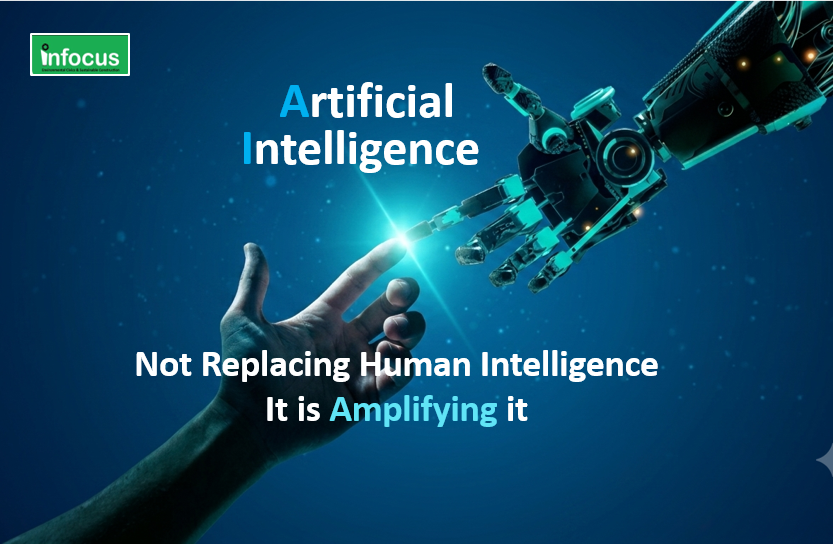
The rise of Artificial Intelligence (AI) has sparked a familiar debate: Is AI making people smarter, or is it making them intellectually lazy? With generative AI tools capable of writing emails, drafting reports, translating languages, generating computer code, planning travel, and answering complex questions in seconds, many fear that humans may gradually lose their ability to think critically. While these concerns deserve attention, history suggests that AI is more likely to become another powerful tool that amplifies human intelligence rather than replaces it. And, it’s a reality that Artificial Intelligence is not replacing Human Intelligence, it is just amplifying it for the future.
Artificial Intelligence under Radar:
Recent scientific studies have highlighted legitimate concerns. Researchers from Carnegie Mellon University and other institutions argue that overreliance on AI could reduce opportunities for learning, memory formation, and critical thinking. Because AI can perform a broad range of cognitive tasks, users may be tempted to outsource thinking itself instead of using technology to support their reasoning. Similarly, a widely discussed 2025 MIT study found that students who relied heavily on generative AI for essay writing demonstrated lower levels of critical engagement, describing the phenomenon as “cognitive surrender.”
These findings should not be ignored. AI, when used carelessly, can encourage convenience over curiosity. If people accept AI-generated answers without questioning or verifying them, they risk weakening the very skills that education seeks to develop—analysis, reasoning, creativity, and independent judgment.
Blaming Every Transformative Technology:
However, it would be inaccurate to conclude that AI is making humanity less intelligent. Throughout history, nearly every transformative technology has faced similar criticism. Ancient Greek philosopher Socrates feared that writing would weaken memory by allowing people to rely on written records instead of remembering information. The printing press was accused of overwhelming society with information. Television was labelled the “idiot box,” calculators were criticised for destroying mathematical ability, and even internet search engines such as Google were once blamed for reducing human intelligence.
Yet none of these technologies diminished human capability. Instead, they expanded it. Calculators did not halt mathematics; they enabled engineers, scientists, and researchers to solve increasingly complex problems with greater speed and accuracy. Computers did not eliminate creativity; they accelerated innovation across medicine, engineering, finance, and countless other fields. Likewise, AI has the potential to remove repetitive mental tasks, allowing humans to focus on higher-value thinking, innovation, and problem-solving.
Towards Technological Breakthroughs:
The key lies in responsible use. AI should complement human intelligence rather than substitute for it. Professionals who already possess the necessary knowledge can use AI to improve productivity, analyse large datasets, generate ideas, and automate routine work. In these cases, AI functions much like previous technological breakthroughs—it enhances efficiency without replacing expertise.
The greater concern lies with children and young learners. Critical thinking, memory, persistence, and reasoning develop through practice. If AI performs these cognitive tasks before young minds have mastered them, essential developmental skills may suffer. This is why parents, teachers, and educational institutions should guide AI usage with appropriate supervision, age-appropriate limits, and an emphasis on understanding rather than simply obtaining answers.
Artificial Intelligence represents one of the most significant technological revolutions of the modern era. Like every major innovation before it, it brings both opportunities and challenges. Rather than fearing AI, society should focus on teaching people how to use it wisely, ethically, and critically. Technology has always been a tool created to extend human potential. AI is no different. It is not replacing intelligence—it is amplifying it, provided humans remain the thinkers behind the technology.
By
Editorial, Infocus.pk