
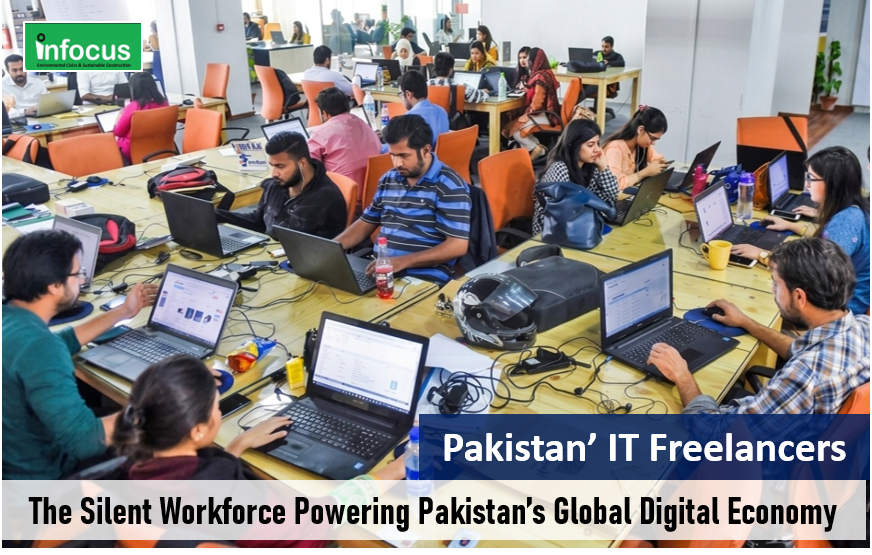
Pakistan’ IT freelancers are rapidly becoming one of the country’s most important contributors to the global digital economy. Working from homes, co-working spaces and technology hubs across cities and smaller towns, thousands of Pakistani Information Technology (IT) professionals are providing software development, graphic design, digital marketing, content creation, virtual assistance, data analytics and other technology services to clients around the world.
Their significance extends far beyond individual earnings. Freelancing has emerged as a relatively low-cost avenue for Pakistan to earn foreign exchange, create employment and establish a presence in international digital markets.
Pakistan’ IT Freelancers, Significance & Potential:
At the first National Recognition Ceremony organised by the Pakistan Freelancers Association (PAFLA), Sindh Governor Syed Muhammad Nehal Hashmi described Pakistani freelancers as an “emerging digital workforce” that is contributing to the national economy, earning valuable foreign exchange and projecting a positive image of Pakistan internationally.
According to figures cited by the governor, Pakistan has nearly three million full-time and part-time freelancers, who earned more than US$1.76 billion through digital services during the last financial year. These figures illustrate the growing economic importance of an industry that operates largely outside the traditional employment structure.

Pakistan’s Global Digital Workforce:
The global market is increasingly based on digital skills rather than geographical boundaries. A developer sitting in Karachi can build an application for a company in London, while a designer in Lahore can work for a client in Dubai and a data analyst in Islamabad can support a business in North America.
This borderless nature gives Pakistan an important opportunity. The country has a large young population, relatively competitive labour costs and an expanding pool of IT professionals. With the right skills, Pakistani freelancers can compete internationally on the basis of quality, specialization and innovation. Freelancing also offers an alternative employment model for young Pakistanis. Instead of waiting for limited domestic job opportunities, skilled professionals can directly access international clients and markets.
From Freelancing to IT Exports:
The real potential of freelancing lies in its ability to become a gateway to Pakistan’s broader IT-export ecosystem. Individual freelancers can eventually develop agencies, software houses, startups and technology companies. The government’s stated ambition to increase Pakistan’s IT exports to US$25 billion by 2030 therefore requires a strong freelance workforce. Millions of digitally connected professionals could become an important component of that export strategy. However, achieving this potential requires more than simply increasing the number of freelancers. Professionals must continuously upgrade their skills as global demand evolves.

The PAFLA President and CEO Dr. Imran Batada rightly highlighted the challenge posed by artificial intelligence, noting that existing experience and skills alone may not guarantee future success. Pakistani freelancers increasingly need expertise in AI, data analytics, cybersecurity, cloud computing, automation and other emerging technologies.
Building a Sustainable Digital Workforce:
Government initiatives such as the Digital Youth Hub and skill-development programmes can help, but training must remain closely connected to international market requirements. Freelancers also need better digital infrastructure, reliable internet, secure international payment mechanisms, professional certification and access to global clients. Most importantly, Pakistan needs to move from viewing freelancers merely as individual online workers to recognizing them as an integral part of the country’s export economy.
Pakistani freelancers may indeed be the country’s “silent heroes.” Their work demonstrates that Pakistan’s most valuable export does not always have to cross a physical border. Sometimes, it travels through a laptop, an internet connection and the skills of a young Pakistani professional. With sustained investment in skills, technology and digital infrastructure, Pakistan’s freelance workforce can evolve from an emerging opportunity into a major pillar of the country’s global economic competitiveness.
By
Editorial, Infocus.pk