
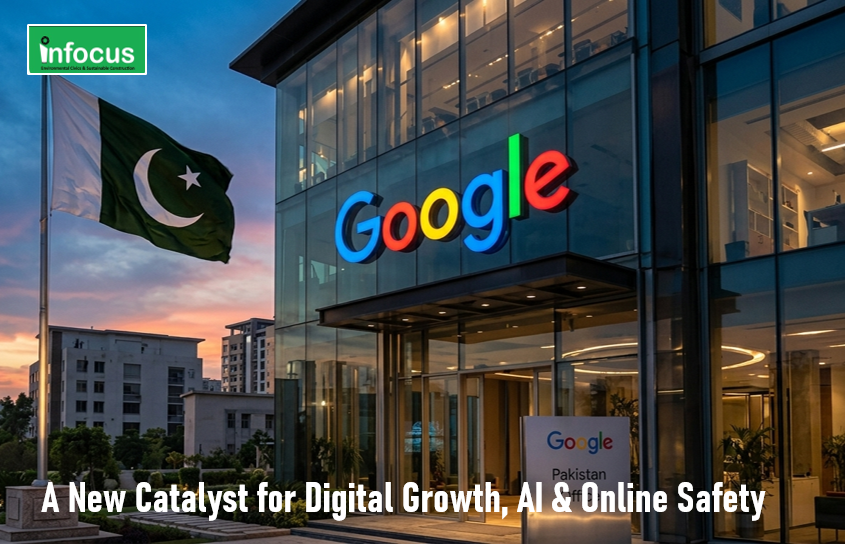
Google’s establishment of its first office in Pakistan, combined with a new cooperation agreement with the Government of Pakistan and a $500,000 Google.org investment in digital safety, represents a significant development for the country’s digital economy. The move is more than the opening of a corporate office. Google’s Pakistan entry signals deeper engagement with country’s technology ecosystem and creates opportunities to accelerate digital skills, artificial intelligence (AI), IT exports, innovation and responsible internet use.
Google’s Pakistan Entry:
Google’s decision to establish its first office in Pakistan marks a significant milestone in the country’s digital transformation. While Google has operated in Pakistan through products, developer communities, education programmes and local partnerships for years, a formal physical presence represents a deeper level of engagement with the country’s technology ecosystem. In November 2025, the Government of Pakistan announced that Google would deepen its local presence to support businesses, innovation and access to global markets.
The significance goes beyond the opening of an office. It is a potential signal of greater international confidence in Pakistan’s digital economy.
The agreement between Pakistan and Google focuses on several areas of national digital transformation. One of the most significant commitments is the expansion of the Google Career Certificates programme, with a target of 150,000 certificates in Pakistan during 2026. Such programmes can help young Pakistanis acquire practical, internationally relevant digital skills and improve their employability in technology-driven industries.

AI Skills and the Future Workforce:
Artificial intelligence is emerging as one of the most important components of Pakistan’s digital future. Under the new agreement, Pakistani students will receive free access for one year to advanced AI tools, including Google AI Plus and Gemini. This could provide students, developers, researchers and aspiring entrepreneurs with valuable opportunities to experiment with AI and integrate it into education, software development, research and business.
The proposed AI Centre of Excellence in Islamabad could further strengthen this ecosystem by training Pakistani youth and human resources according to global market requirements. If properly implemented, it could help Pakistan move beyond being a consumer of AI products towards becoming a developer and exporter of AI-enabled solutions.
Boosting IT Exports and Startups:
Pakistan has set ambitious targets for expanding its IT and digital economy. Cooperation with Google could support this objective by improving the global competitiveness of Pakistani software companies, mobile application developers, gaming studios, freelancers and digital entrepreneurs.
The proposed government-Google task force to identify barriers and opportunities for IT exports is particularly important. Pakistan needs to move towards higher-value technology services rather than relying predominantly on low-cost outsourcing. AI, cloud computing, cybersecurity, gaming, mobile applications and digital platforms can provide pathways towards greater export revenues. Google’s local presence in Karachi can also help connect Pakistani businesses with international technology ecosystems and markets, potentially strengthening investor confidence in the country’s digital sector.

Digital Transformation Beyond IT:
The partnership has significance beyond technology exports. The two sides plan to explore AI-powered data analytics for the Federal Board of Revenue, AI applications in agriculture and digital platforms that can help small and medium-sized enterprises reach international markets. Such applications demonstrate how digital technology can contribute to productivity and governance across the wider economy.
Google’s $500,000 investment in the Digital Pasban initiative adds another important dimension to its Pakistan strategy. The programme aims to provide 200,000 households with Urdu-language digital safety toolkits, videos and parental workshops.
This is particularly relevant as more Pakistani children and families gain access to the internet. Digital expansion must be accompanied by awareness about cyberbullying, online grooming, inappropriate content, privacy and other digital risks. The cooperation between Google and the Pakistan Telecommunication Authority on child online safety can help strengthen preventive education and responsible internet use.
From Digital Consumer to Digital Producer:
Google’s growing presence presents Pakistan with a valuable opportunity—but the benefits will not be automatic. Universities must develop industry-ready talent, businesses need reliable digital infrastructure, startups require investment, and policymakers must create predictable regulatory and data-governance frameworks.
If these elements come together, Google’s Pakistan presence could become a catalyst for a broader transformation: from a country that primarily consumes global digital technologies to one that develops, exports and innovates with them.
The real measure of this partnership will ultimately be the opportunities it creates for Pakistani youth, businesses and technology entrepreneurs—and whether it helps turn Pakistan’s digital potential into sustainable economic growth.
By
Editorial, Infocus.pk