
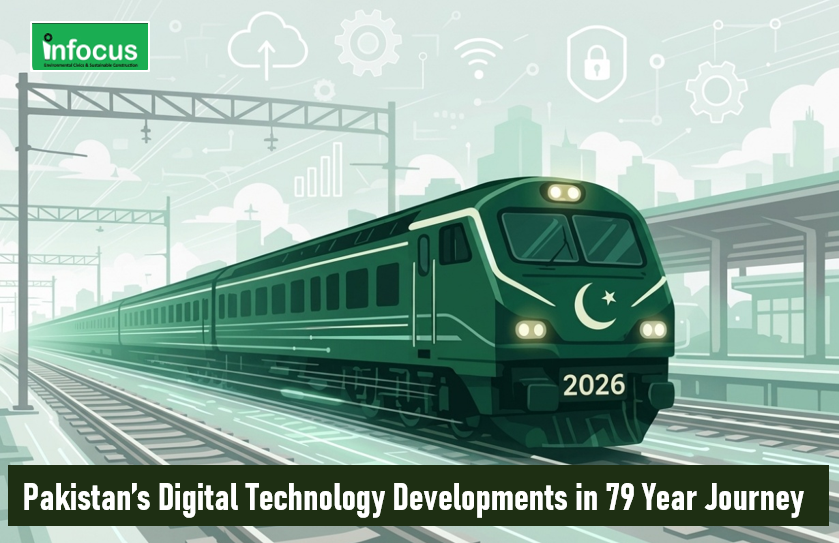
As Pakistan completes 79 years since independence, its technological journey reflects a remarkable transition—from a country with limited industrial and scientific infrastructure in 1947 to an emerging digital economy with a growing software industry, technology startups, freelancers, telecom networks, digital services and artificial intelligence capabilities. Although progress has been uneven, Pakistan has developed an increasingly important technology ecosystem that is now contributing billions of dollars to the national economy. Today, Pakistan’s Digital Technology Developments reflects progressing rapidly toward a modern, tech-driven economy powered by a flourishing startup ecosystem, expanding digital infrastructure, and a dynamic, young talent pool leading the way in global innovation.
Pakistan’s Digital Technology Developments:
Continual advancement in science in technology has been pivotal for Pakistan digital tech developments. In the early decades after independence, Pakistan concentrated on building scientific and engineering institutions. Organisations such as the Pakistan Atomic Energy Commission, SUPARCO and the National Engineering and Scientific Commission (NESCOM) contributed to the country’s capabilities in nuclear science, aerospace, electronics, engineering and defence technologies.
The development of Pakistan’s satellite and space capabilities, including the Badr satellite programme, demonstrated that technological innovation could emerge despite limited resources.
Information and Communication Technology (ICT):
The arrival of computers and telecommunications gradually transformed the economic landscape. During the 1980s and 1990s, universities and public institutions began producing computer scientists and engineers, while banks, businesses and government departments started adopting information systems. The expansion of cellular telecommunications and internet connectivity in the 2000s subsequently created the foundation for a much broader digital economy.
Digital Services Expansion:
Pakistan’s software industry became one of the most significant outcomes of this transformation. Pakistani companies began providing software development, business-process outsourcing, IT consulting, cybersecurity, gaming, animation, mobile applications and other digital services to international clients. Freelancing further expanded this ecosystem by allowing Pakistani professionals to sell their skills directly to global markets.

The scale of this transformation is now visible in export figures. Pakistan’s ICT export earnings reached a record $4.6 billion in FY2025-26, representing around 20.6 percent annual growth and the highest-ever ICT trade surplus among the country’s services sectors. The country also had 34,420 registered IT and IT-enabled services companies by March 2026, illustrating the expanding entrepreneurial base.
Cellular Advancement leads Tech Achievements:
Telecommunications has been another major success story. Mobile connectivity has expanded to cover approximately 92 percent of the population, while broadband penetration reached 64.2 percent in FY2025-26. The country has also moved toward 5G, with a major spectrum auction held in 2026.
Pakistan’s technology achievements increasingly extend beyond traditional software outsourcing. Startups, Fintech, e-commerce, cloud computing, cybersecurity, artificial intelligence, health technology, AgriTech and SaaS products are creating new areas of innovation. National Incubation Centres have supported more than 1,300 startups, while government programmes are expanding digital skills and technology entrepreneurship.
AI & E-Governance:
Artificial intelligence represents the next major frontier. The National AI Policy 2025, AI research centres at universities, sovereign computing initiatives and growing private-sector experimentation demonstrate Pakistan’s ambition to move from consuming technology to developing indigenous digital capabilities.

Digital government is also expanding. More public services are moving online, digital payments are becoming increasingly common, and initiatives under the Digital Nation Pakistan framework are attempting to create more integrated digital public infrastructure.
Obstacles & Future:
Yet Pakistan’s 79-year technological journey is not without shortcomings. Internet disruptions, expensive connectivity, limited research funding, shortages of advanced technical skills, weak university-industry collaboration and insufficient investment in original product development remain major challenges. The country still needs to move beyond providing relatively low-cost IT services toward building globally competitive intellectual property, software products, platforms and deep-tech companies.
Nevertheless, the trajectory is clear. From early scientific institutions to satellites, telecom networks, software houses, freelancers, startups and AI research, Pakistan has built a substantial technological foundation in 79 years. The next 21 years—leading toward 2047—could determine whether Pakistan remains primarily a digital services provider or becomes a creator and exporter of globally significant technology products and intellectual property.
By
Editorial, Infocus.pk