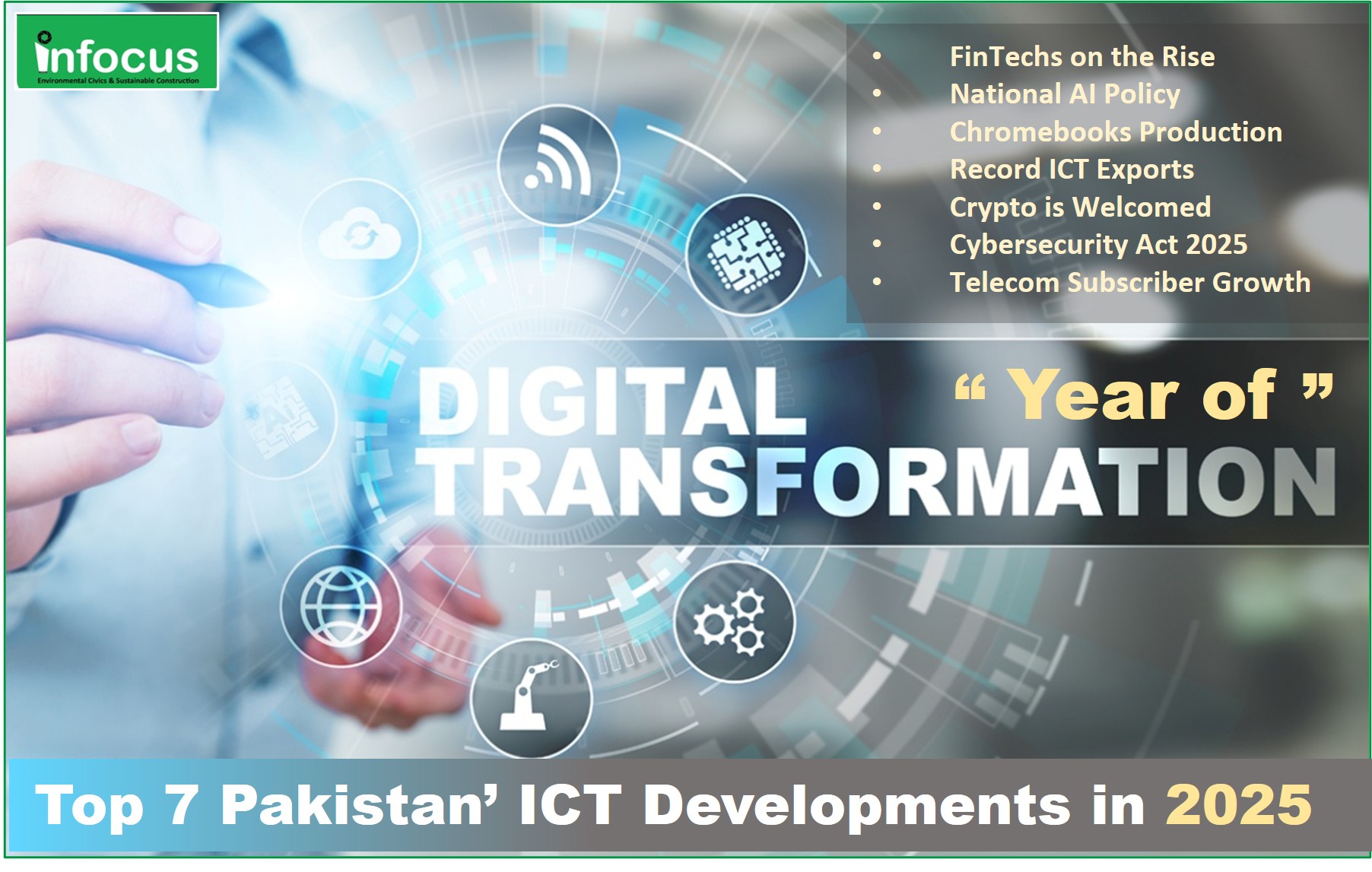
The 2025 has been a year of digital transformation, with significant policy developments, and global recognition for Pakistan’s growing Information and Communication Technology (ICT) sector. With soaring IT exports to Artificial Intelligence (AI) policy adoption, and major digital infrastructure growth, including Chromebook production and IoT adoption in industries, as well as enhanced digital payments this year, mark a strong shift towards a knowledge economy. Besides, participation in key international ICT events solidified Pakistan’ global presence.
Year of Digital Transformation:
This digital development doesn’t exclude major IT infrastructure expansion like 5G Rollout, addressing internet speed issues and enhancing mobile connectivity. The IoT growth with smart manufacturing and real-time monitoring in industries like oil & gas saw significant adoption. Especially, oil marketing companies deployed ERP systems to integrate with national tracking systems, and the sector saw digital transformation initiatives across the board.
Moreover, Pakistan actively participated in events like GITEX Global and London Tech Week and LEAP 2025 promoting its tech capabilities in AI, cybersecurity, and software development.
However, the Top 7 Pakistan’ ICT Developments in 2025 are;
- National AI Policy:
The government approved the national Artificial Intelligence (AI) Policy 2025, focusing on ethical, inclusive AI to drive socio-economic progress, supported by private AI cloud platforms. Key features of the Policy are;
- Training a million AI professionals by 2030
- Creating 50,000 AI-driven civic projects
- An AI Venture Fund with Private Sector
- An AI Council to oversee policy’ matrix
- Establishing an AI Innovation Fund
- Creating 1,000 local AI products
- Giving 3000 AI Scholarship
- Facilitating 1000 AI Research projects.
2. Production of Google Chromebooks:
Pakistan vastly relies on imports for computers and Information Technology (IT) hardware, despite being a top IT-services exporting nation in the world. But this year, Pakistan has launched its first Google Chromebook assembly line, with the goal of producing 500,000 Chromebooks annually by 2026.

According to the details, Google, Tech Valley, Allied, and the National Radio & Telecommunication Corporation (NRTC) launch the Google Chromebooks assembly line to produce 500,000 devices by 2026, boosting education and job creation for the digital economy and paving the way for exports.
3. Record ICT Exports:
While exports may not have been doing well, Information and Communication Technology (ICT) exports surged past $5 billion, driven by a large youth talent pool and competitive pricing, with companies showcasing innovation globally. Only in October this year the exports reached an all-time high of $386 million. The target for FY26 is $5bn, of which $1.8bn has been achieved. This means the country will have to average roughly half a billion dollars in exports for the remainder of the fiscal year – a tall order but not undoable.
4. Crypto is Welcomed:
From considering it illegal to creating a regulatory environment in hyperdrive, crypto has had a very interesting year in Pakistan. Pakistan has already established the Pakistan Crypto Council (PCC), a government-backed initiative launched in March 2025 to regulate the country’s digital assets and blockchain technology sector. The PCC operates under the Ministry of Finance and is focused on moving Pakistan’s large informal crypto market into a structured, legal, and investment-friendly ecosystem.
On the other hand, Binance has signed agreements with JazzCash and Fauji Foundation to explore collaborations across the crypto ecosystem. It looks the 2026 be the year when crypto will be legal in Pakistan?
5. FinTechs on the Rise:
The value of retail transactions through digital channels showed remarkable growth this year. As digital transactions crossed Rs. 60 trillion in FY2025, showing high adoption. These figures highlight a robust shift toward a digital-first economy. Pakistan`s payment systems are increasingly reflecting the outcomes of sustained policy focus on digitization and market innovation. Regulatory initiatives led by the State Bank, alongside operational advancements by banks, Electronic Money Institutions (EMIs), and FinTechs like Raast Instant Payment System, mobile wallets, Point-of-sale (PoS) and e-commerce activity, have collectively enhanced the accessibility, efficiency and usability of digital payment channels.

- 6. Cybersecurity Act 2025:
The Ministry of Information Technology and Telecom intends to implement the Cybersecurity Act 2025, a major legislative step to create a dedicated National Cybersecurity Authority (NCA) for national security, incident response (enhancing PKCERT), and secure digital infrastructure, building on the existing National Cybersecurity Policy 2021 and strengthening the framework beyond the older Prevention of Electronic Crimes Act (PECA). This new Act focuses on protecting Critical Information Infrastructure (CII) like NADRA, FBR, and telecom, aiming for a secure, resilient digital Pakistan through better coordination, capacity building, and global standards.
- 7. Telecom Subscriber Growth:
According to the Pakistan Telecommunication Authority (PTA) the number of telecom subscribers in Pakistan has reached 200 million in 2025. In its annual report for 2024–25, the PTA report said broadband connections have crossed 150 million, while telecom coverage now stands at more than 92% and broadband penetration has risen above 60%. The authority also said total revenue of the telecom sector has exceeded one trillion rupees, marking a year-on-year increase of 12%. The sector’s contribution to the national exchequer has reached 402 billion rupees, compared with Rs336 billion in 2024. Also, to strengthen regional connectivity, four new high-capacity submarine cables are being added.
By
Editorial, Infocus