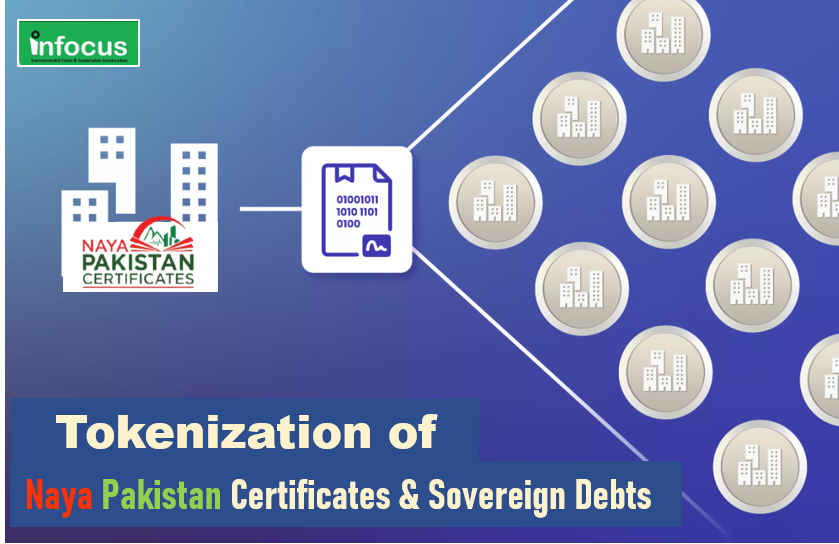
Pakistan is increasingly exploring digital finance reforms to modernize its economy and attract overseas investment. The proposal by the Ministry of Finance, the State Bank of Pakistan (SBP), and the newly formed Pakistan Virtual Assets Regulatory Authority (PVARA) to initiate tokenization of Naya Pakistan Certificates (NPCs) and sovereign debt via Digitally Native Notes (DNNs) is a highly ambitious leap into modern financial market infrastructure. As, despite its promising outlook, tokenization also carries significant financial, legal, and technological risks.
Tokenization of Naya Pakistan Certificates:
According to news reports, Pakistan is exploring the venue of the tokenization of sovereign debt instruments and Naya Pakistan Certificates, as part of efforts to modernize Pakistan’s financial infrastructure and expand investor access through blockchain technology. In a meeting between Finance Minister Muhammad Aurangzeb, Minister of State and Chairman of the Pakistan Virtual Assets Regulatory Authority Bilal Bin Saqib, and Adviser on Debt Management Omer Khan, the possible structures, implementation pathways, regulatory requirements and next steps for introducing tokenized sovereign instruments within Pakistan’s evolving financial ecosystem was discussed.
The model under consideration involves the issuance of digitally native sovereign notes through a regulated blockchain-based financial market infrastructure, enabling same-day settlement while remaining interoperable with conventional international clearing and settlement systems linked to Pakistan’s existing Eurobond program. The proposal would allow coupon payments, secondary market trading and final repayments to continue through established global financial infrastructure, ensuring compatibility with institutional investors participating in Pakistan’s sovereign debt market. The meeting also reviewed the potential tokenization of NPCs to improve accessibility for overseas Pakistanis and broaden retail investor participation through digital investment channels connected to global markets.
Naya Pakistan Certificates:
The Government of Pakistan and the State Bank of Pakistan launched the Naya Pakistan Certificates in November 2020. The scheme was officially inaugurated by former Prime Minister Imran Khan as an investment avenue primarily for overseas Pakistanis and resident Pakistanis with declared assets abroad. The certificates are an initiative of the Ministry of Finance and are administered by the State Bank of Pakistan. They were introduced alongside the Roshan Digital Account to allow eligible individuals to invest in both conventional and Shariah-compliant (Islamic) instruments in multiple currencies, including USD, GBP, Euro, and PKR. Officials in the above meeting noted that the Roshan Digital Account initiative has attracted nearly $13 billion in cumulative inflows since its launch in 2020, with most of the funds deployed within Pakistan’s economy.
Digitally Native Notes (DNNs):
On the other hand, Digitally Native Notes (DNNs) are debt securities issued, traded, and settled entirely in electronic format on a blockchain or distributed ledger. Unlike traditional bonds that require physical certificates or manual clearing processes, DNNs leverage smart contracts for instantaneous settlement and automated interest payouts, fundamentally reducing issuance costs and counterparty risks. While the initiative promises same-day settlement, fractional ownership, and seamless digital rails for overseas Pakistanis, a critical counter-analysis reveals significant domestic and structural hurdles.
For DNNs and tokenized NPCs to successfully scale beyond a “$2 billion pilot project,” the government cannot view it purely as a tech upgrade. It will require a massive push toward user-friendly retail abstraction (hiding the blockchain complexity behind regular apps), absolute regulatory harmony between SBP and PVARA, and sustained macroeconomic stability to give global investors’ confidence in the underlying debt.
Obstacles towards Tokenization:
For this ecosystem to truly prosper, it must overcome five formidable roadblocks:
1. The Dual-System Complexity (Interoperability Risk): The proposed DNN model relies on a hybrid framework where the sovereign bond is born on a regulated blockchain but immediately hooks into conventional international clearing and settlement systems for coupon payments and secondary trading. Managing a “split personality” for sovereign debt means the SBP and National Clearing Company of Pakistan (NCCPL) must seamlessly synchronize legacy, T+2 manual clearing processes with real-time, programmable blockchain ledgers. If the bridge between the digital native note and the traditional fiat/clearing system lags or suffers from technical latency, the primary advantage of blockchain—speed and risk reduction—is neutralized.

2. Sovereign Cyber Security and Infrastructure Deficits: Deploying a nation’s sovereign debt market onto a regulated blockchain demands an ironclad digital infrastructure. Pakistan frequently battles localized digital challenges, including internet disruptions, routing issues, and an evolving national cybersecurity landscape. A regulated financial blockchain requires 100% uptime across all validator nodes (SBP, PVARA, partner banks). Any perception of network vulnerability, node centralized failures, or smart contract bugs at the sovereign level could trigger immense reputational damage, scaring away foreign capital instantly.
3. Regulatory Maturity and Institutional Friction: Pakistan has only recently established the Pakistan Virtual Assets Regulatory Authority. Historically, the SBP and the Securities and Exchange Commission of Pakistan have maintained a highly cautious, restrictive stance toward digital assets and blockchain networks. Tokenized bonds require smart contracts to autonomously execute coupon distribution and secondary market compliance rules. Building a brand-new legal framework that harmonizes PVARA’s digital asset oversight with the SBP’s banking regulations will take years. Institutional inertia and overlapping jurisdictions could strangle the initiative in red tape before a single pilot is scaled.
4. High On-Ramp Friction for Retail and Overseas Investors: A major goal of tokenizing NPCs is to broaden retail access and streamline investment via the Roshan Digital Account (RDA) ecosystem (which has brought in nearly $13 billion). However, tokenization introduces a new technological layer. For an ordinary overseas Pakistani or domestic retail saver, interacting with digital asset wallets, cryptographic keys, or specialized “Digital FMI” platforms is vastly more complex than using a standard banking app. If the user interface requires navigating Web3 architecture, compliance checks (KYC/AML) tailored for digital tokens, or dealing with digital custody risks, retail investors will simply default back to conventional, familiar banking channels.
5. The Macroeconomic Elephant in the Room: Technology cannot fix structural economic headwinds. The primary drivers of investor appetite for Naya Pakistan Certificates and sovereign bonds are macroeconomic stability, sovereign credit ratings, inflation rates, and foreign exchange risks. If an investor is concerned about currency depreciation or fiscal deficits, moving the underlying debt from a traditional registry onto a blockchain ledger does not fundamentally alter the risk-return profile of the asset. Tokenization optimizes efficiency, not yield or creditworthiness. Without stable macroeconomic indicators, global retail and institutional investors will remain wary, regardless of how advanced the underlying financial tech is.
Lastly, for Pakistan to successfully implement blockchain-based NPC s as well as DNNs, policymakers must first establish a robust legal framework, secure digital infrastructure, and international compliance standards. If managed carefully, tokenized sovereign investment instruments could position Pakistan as a forward-looking digital economy in South Asia.
By
Editorial, Infocus.pk