
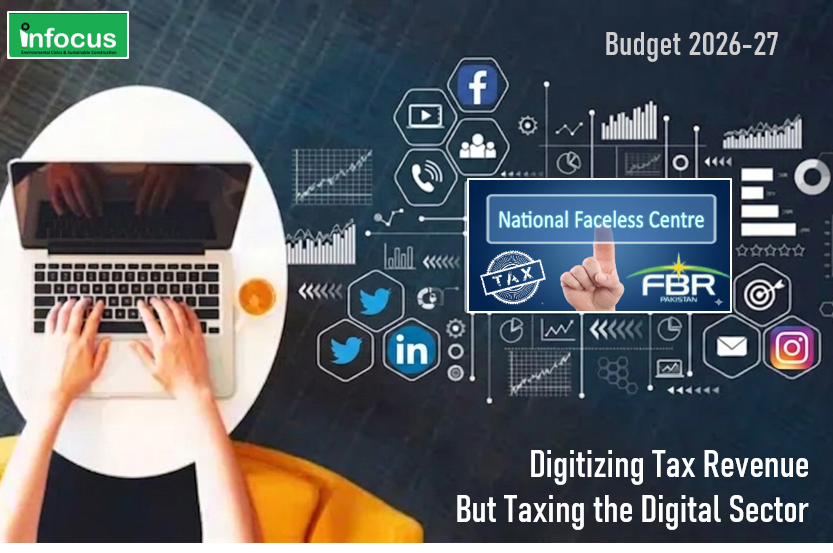
Pakistan’s Budget 2026-27 presents a dubious picture for the country’s economic modernization agenda as well as digital transformation. On one hand, the government is taking a significant step toward digitizing tax administration by introducing technology-driven mechanisms for audits, assessments, and appeals. On the other, it has chosen to impose new withholding taxes on digital content creators and social media influencers, raising concerns about whether the emerging digital economy is being encouraged or burdened. The contrast within the budget is striking. It creates a perception that while digital systems are being embraced for revenue collection, digital entrepreneurship is being treated primarily as a source of taxation rather than a sector requiring support and incentives.
Budget 2026-27 & Digital Contradictions:
Pakistan’s long-term economic future depends heavily on digital transformation. Policymakers have tried to craft a careful balance between expanding the tax base and fostering innovation in the Budget 2026-27. The government seeks to digitize tax administration through technology and automation, yet it imposes additional taxation on one of the fastest-growing segments of the digital economy.
Following are key measures of the Budget 2016-27, pertaining to Information Technology (IT) and IT enabled Services (ITeS):
- Concessionary Final Tax Regime of 0.25% extended for IT & ITeS Exports.
- Rs. 5,290.49 million allocated to train 120,000 youth in IT and digital skills.
- Withholding Tax introduced on Social Media influencers’ revenue from Youtube, Facebook, Instagram, Tiktok and etc.
The first measure was taken to keep tech investors from fleeing, therefore government has extended the 0.25% concessionary export tax until 2029 to support exporters. In the same wavelength, Rs. 5,290.49m has been earmarked for training 120,000 youth under the existing PM`s program. But knowing the rising unemployment rate, the budget contains no specific allocation for employment generation or any dedicated jobs program.
Taxing Digital Content Creators:
The budget also introduces measures to bring previously under-taxed segments into the formal tax net. And, the prime target are digital content creators. Perhaps the government is of the views that the sector has strong revenue potential with relatively low capital requirements. However, the timing and structure of the measure have raised concerns among digital entrepreneurs. Pakistan’s content creation industry is still developing compared to global markets. Thousands of young Pakistanis have built careers as influencers, educators, freelancers, video producers, and digital marketers. Many earn foreign exchange for the country through online platforms.
The sector also has the capacity to generate employment for educated youth. A good number of young freelancers learn IT skills and keep themselves updated via digital content uploaded on social media platform. Digital content creators and influencers should certainly contribute to the tax system, but taxation policies must be designed in a manner that encourages growth, exports, and formalization rather than creating barriers. However unfortunately, what government overlooked in the budget is the IT infrastructural human resource development. Initiatives like the National Semiconductor HR Development Program and the Semiconductor Chip Design Upskilling pilot project aim to position Pakistan within the global semiconductor market, projected to exceed $1tr by 2030. Neither some amount of allocation nor any incentive mentioned in the budget documents.
Digital Transformation of FBR:
The budget reflects the Federal Board of Revenue’s (FBR) continued push toward digital transformation. One of the most notable reforms is the establishment of a National Faceless Centre (NFC), through which audits, assessments, and appeals of submitted tax returns will be conducted digitally. The concept is inspired by international models that aim to reduce human interaction, increase transparency, and minimize opportunities for corruption. Under the proposed framework, taxpayers will no longer need to physically visit tax offices or interact directly with tax officials for many routine proceedings. Instead, communications, notices, responses, hearings, and decisions will be managed through online platforms. In theory, this should create a more efficient, transparent, and taxpayer-friendly system.
However, the effectiveness of the National Faceless Centre remains uncertain. Till this date the system is entirely untested in Pakistan, where digital governance projects have often struggled with implementation challenges, technical glitches, and limited institutional capacity. Taxpayers and tax professionals alike are questioning whether the infrastructure, cybersecurity safeguards, and human resources required for such an ambitious initiative are fully in place.
Besides, success of faceless tax administration depends heavily on reliable technology, efficient data integration, and prompt resolution of disputes. Any delays, system failures, or lack of accountability could create frustration rather than convenience. However, the biggest hurdle is FBR`s poor track record. As it has consistently missed its annual targets, including the one for the outgoing year.
The Budget 2026-27 marks overall an important milestone in tax digitization. Whether it becomes a success story will depend on how effectively the National Faceless Centre functions and whether the taxation of digital creators is implemented in a way that supports, rather than stifles, Pakistan’s emerging digital economy.
By
Editorial, Infocus.pk